
Updated November 2026.
FinOps for AI applies the cloud cost playbook (visibility, allocation, optimization, accountability) to AI spend: model API calls, GPU capacity, AI features inside SaaS tools and coding assistants. It became the top forward-looking priority in the FinOps Foundation’s State of FinOps 2026, and 98% of practitioners now manage AI spend, up from 31% two years earlier.
The playbook needs changes, though. AI costs arrive through more channels than cloud, the unit is a token most business people cannot picture, and a single agent loop can burn a monthly budget in a day. This guide covers what is different and what to do about it.
Why AI spend is harder than cloud spend
The FinOps Foundation’s 2026 working paper on token economics lists the problems practitioners keep running into:
- Bills without business context. Provider invoices break spend down by API key, project or workspace at best, never by product or cost center.
- Developer-led buying. Engineers can start calling a model within minutes, sometimes on a card finance cannot see.
- Fast model turnover. The best price-performance model for a task can change every few months.
- Sudden spikes. Agent loops, longer prompts or a traffic surge can exceed a monthly budget within a day, and native rate limits are set in tokens per minute, not dollars.
- An unfamiliar unit. Few stakeholders can translate a token budget into an outcome.
Budgets reflect this. Futurum’s second-half 2026 CIO survey, cited by Finout, found about 46.9% of organizations spent more on AI than planned, and only 5.6% came in under. CloudZero’s 2026 survey found 40% of companies spend more than $10 million a year on AI.
Where AI spend comes from
The first job is knowing every channel. The FinOps Foundation groups them like this:
| Channel | How it bills | Allocation difficulty | Spike risk |
|---|---|---|---|
| Direct model provider API (OpenAI, Anthropic, Google) | Per token | High | Very high |
| Cloud provider model services (Bedrock, Azure OpenAI, Vertex) | Per token, on the cloud bill | Medium | Medium to high |
| Model routers or aggregators | Credits or per token | Medium to high | High |
| Self-hosted open-weight models | GPU and compute hours | Low | Low to medium |
| AI embedded in SaaS | Per seat or add-on | Low | Low |
| AI developer tools (Copilot, Cursor, Claude Code) | Seat plus usage, or per token | Medium to high | Medium to high |
Each channel needs a different control. Cloud model services inherit your existing tags and budgets. Direct APIs need key governance and usually a gateway. Developer tools moved toward usage billing in 2026: GitHub Copilot switched to AI credits on June 1, and Cursor’s October plans bill third-party models at API list price from the first request, as covered in Cursor pricing and Cursor cost management.
Step 1: Inventory and key governance
Catalog every provider account, API key, contract and payment method in the company. Then map each key to exactly one team, application and cost center, with a named owner. Shared keys are the AI equivalent of untagged resources: spend nobody can explain.
Move card-paid accounts onto central billing where possible. It closes the visibility gap and usually unlocks better terms.
Step 2: Attribute every call
Start with what providers give you natively: projects, workspaces and per-key usage. When you need cross-provider views or per-request metadata (customer ID, feature, environment), put a gateway or proxy in front of model calls and log each request with its cost.
Tag at the request level, not just the key level. A customer ID on each call turns AI spend into a direct cost in your cost per customer model instead of an unallocated lump. For the per-token math, see cost per token.
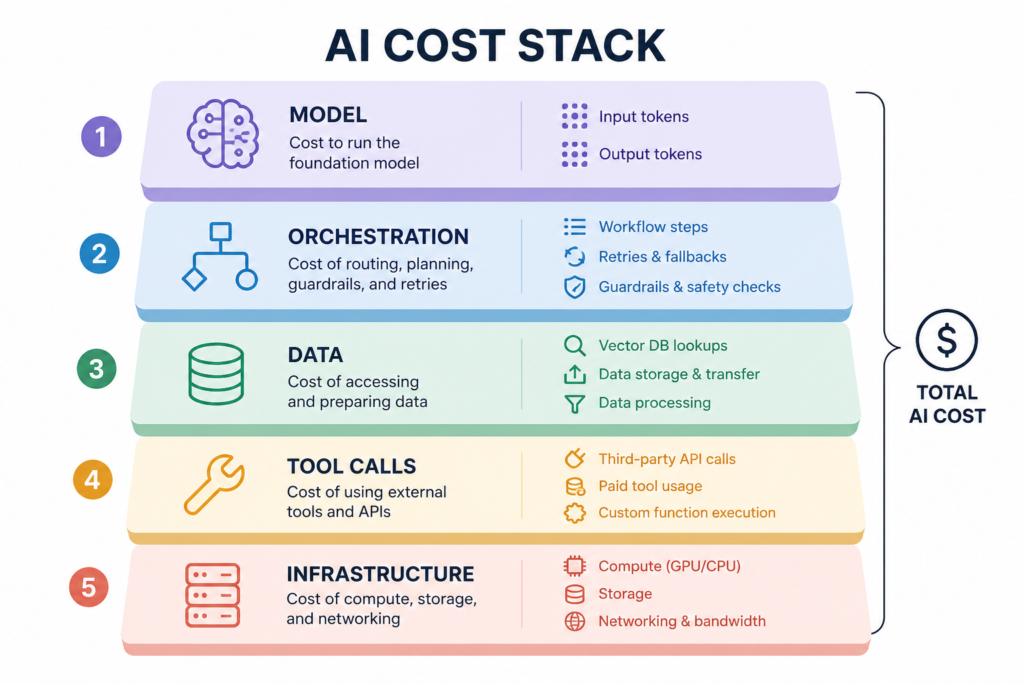
Count the full cost of a feature, not just the model invoice. In retrieval and agent architectures, the Foundation’s paper says surrounding infrastructure (vector databases, orchestration, storage, observability) can be 40% to 60% of feature spend, and none of it shows on the model provider’s bill.
Step 3: Budgets, alerts and hard caps
Set budgets from measured usage, not guesses. The Foundation suggests budgets at 110% to 120% of a measured baseline, with alerts at 80% and 100%.
Alerts are not enough for AI, because a runaway agent can blow through a budget overnight. Add hard stops where the platform allows:
- Per-key or per-project spend limits in provider consoles.
- Spend caps on cloud AI services. Google Cloud put Spend Caps into private preview in April 2026 for services including Google AI Studio and its agent platform.
- Usage budgets in coding tools. Copilot Business and Enterprise let admins set budgets at enterprise, cost center and user level.
- Gateway-level quotas per team or per customer.
Anomaly detection still matters for what slips through; our AWS Cost Explorer guide shows how to set it up for AI services on AWS.
Step 4: Optimize in the right order
The Foundation’s advice is to right-size models before pulling other levers, because model choice moves cost more than anything else. It reports that routing requests to the cheapest model that can handle them can cut average cost per query by 60% to 80%.
Then work down the list:
| Lever | What it does | Watch out for |
|---|---|---|
| Model routing | Sends easy requests to small models | Quality checks on the routed traffic |
| Prompt caching | Reuses repeated context at a discount | Cache hit rate, cache write costs |
| Batch APIs | Cheaper rates for non-urgent work | Hours of latency |
| Context management | Trims history and retrieved chunks | Answer quality |
| Output length limits | Caps expensive output tokens | Truncated answers |
| Self-hosting open-weight models | Trades tokens for GPU hours | Utilization, ops effort |
Our guides to reducing OpenAI API cost and cost per token go through each technique with numbers.
Step 5: Commit only after a baseline
Discounts for committed AI spend are spreading. Google introduced Gemini Enterprise flexible savings plans in August 2026 with 10% to 20% off in exchange for a spending commitment, and cloud providers offer committed pricing on their model services. The Foundation recommends 60 to 90 days of instrumented usage before negotiating any commitment, which matches the cloud rule of committing to the floor, not the peak. Reserved vs Spot vs On-Demand explains the same logic for compute.
Step 6: Measure value, not just cost
In the Foundation’s September 2026 State of Tokenomics survey, proving value or ROI was the most common challenge, named by 43% of respondents. Only 4% asked providers for lower prices; 23% asked for more transparency and granular data.
So pair every AI cost metric with an outcome the business owns:
- Cost per resolved support ticket for an AI agent
- Cost per merged pull request for coding assistants
- Cost per document processed for extraction pipelines
- AI cost as a share of revenue per customer segment
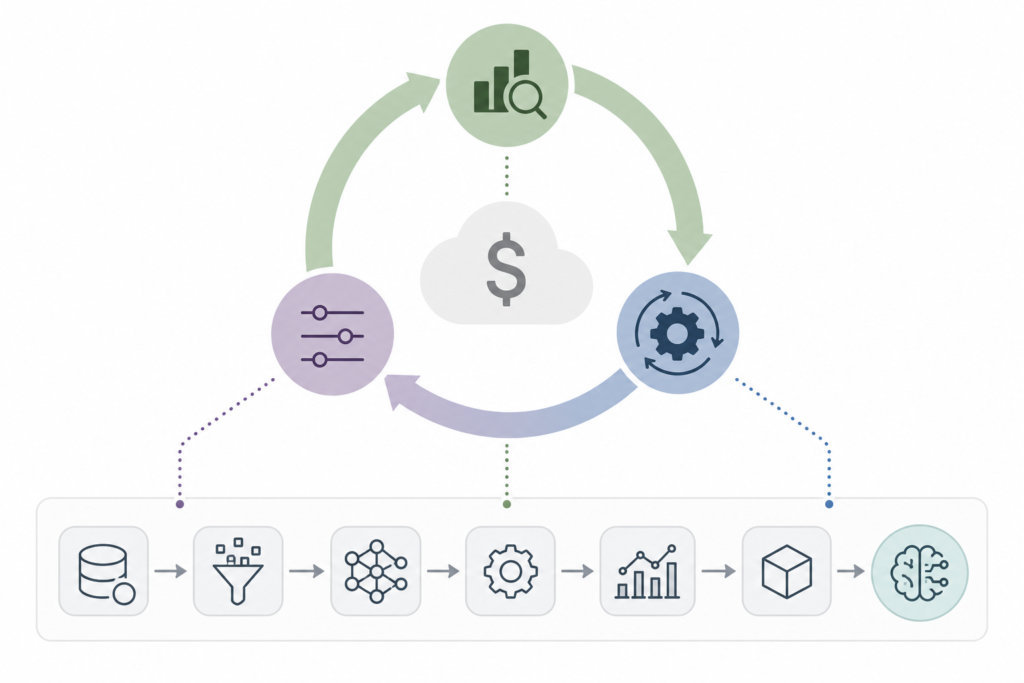
In a hypothetical case, a feature that costs $0.40 per resolved ticket against a $6 human cost is cheap, while one that costs $0.05 per request but resolves nothing is expensive. Tying AI cost to cost per customer and outcomes is where FinOps for AI earns its place in planning meetings.
The standards arriving in 2026
AI cost data is starting to get the same standardization cloud billing got through FOCUS.
- FOCUS 1.3 (December 2025) added split cost allocation and a contract commitments dataset.
- FOCUS 1.4 was ratified on June 4, 2026, adding invoice reconciliation and deeper commitment data.
- FOCUS 1.5, previewed for around the end of 2026, brings token and model identity into the specification, plus a price sheet dataset.
- The Tokenomics Foundation, announced by the Linux Foundation in June 2026 with backing from Google, Microsoft, IBM, JPMorgan and Salesforce, is building open standards and benchmarks for AI token economics. The Linux Foundation also plans a Tokenomicon event for June 2027.
Microsoft already maps Azure OpenAI token usage into FOCUS data in its FinOps toolkit, splitting cost by model, version and input or output tokens. If your tools speak FOCUS, AI spend will slot into the same reports as cloud.
Who should own AI costs?
AI spend crosses engineering, product, procurement and finance, which is why it falls through gaps. A workable split:
- FinOps team: data, allocation rules, reports, anomaly response.
- Engineering and product: model choice, routing, caching, unit cost targets per feature.
- Procurement: contracts, commitments, consolidation of card-paid accounts.
- Finance: budgets, forecasting, value tracking.
The State of FinOps data shows AI cost management is the most wanted skill to add to FinOps teams, so expect to train people rather than hire a separate AI FinOps function. See FinOps statistics for the numbers and what is FinOps for the operating model.
A 30-day starter plan
- Week 1: list every AI provider account, key and tool, with owner and payment method.
- Week 2: map keys to teams and cost centers; move card-paid accounts to central billing.
- Week 3: set budgets and alerts from last month’s usage, and hard caps on the riskiest keys.
- Week 4: pick one high-volume feature, measure its cost per outcome, and test a cheaper model on part of its traffic.
Questions people ask
What is FinOps for AI?
It is the practice of managing the cost and value of AI spend (model APIs, GPUs, AI tools and AI inside SaaS) with the same visibility, allocation and accountability FinOps applies to cloud.
What is the biggest lever for cutting AI costs?
Model choice. Routing simple requests to smaller models can cut average cost per query by 60% to 80%, according to the FinOps Foundation.
How do I stop surprise AI bills?
Use hard spend caps where providers offer them, budgets with alerts at 80% and 100%, per-key ownership and a gateway that logs cost per request.
Do I need a separate tool for AI costs?
Not always. Cloud model services appear on your existing cloud bill, and most FinOps platforms now ingest direct API spend. Check FOCUS support when choosing.
Sources
- State of FinOps 2026 (FinOps Foundation data site)
- Managing AI token costs: State of Tokenomics (FinOps Foundation)
- AI cost management platform pricing (Finout, citing Futurum)
- FinOps in the AI Era press release (CloudZero)
- FinOps X 2026 recap (Flexera)
- Linux Foundation announces Tokenomicon (TechTarget)
- Tokenomics Foundation launch (The New Stack)
- Introducing FOCUS 1.3 (FinOps Foundation)
- Gemini Enterprise pricing changes (Gartner First Take)
- Managing Azure OpenAI costs with the FinOps toolkit and FOCUS (Microsoft)
- GitHub Copilot is moving to usage-based billing (GitHub Blog)


Pingback: Cloud Cost Optimization Checklist: 40 Checks for 2026
Pingback: Cloud Cost Allocation: Tags, Shared Costs and Chargeback
Pingback: ChatGPT vs Claude vs Gemini Enterprise Pricing (2026)