
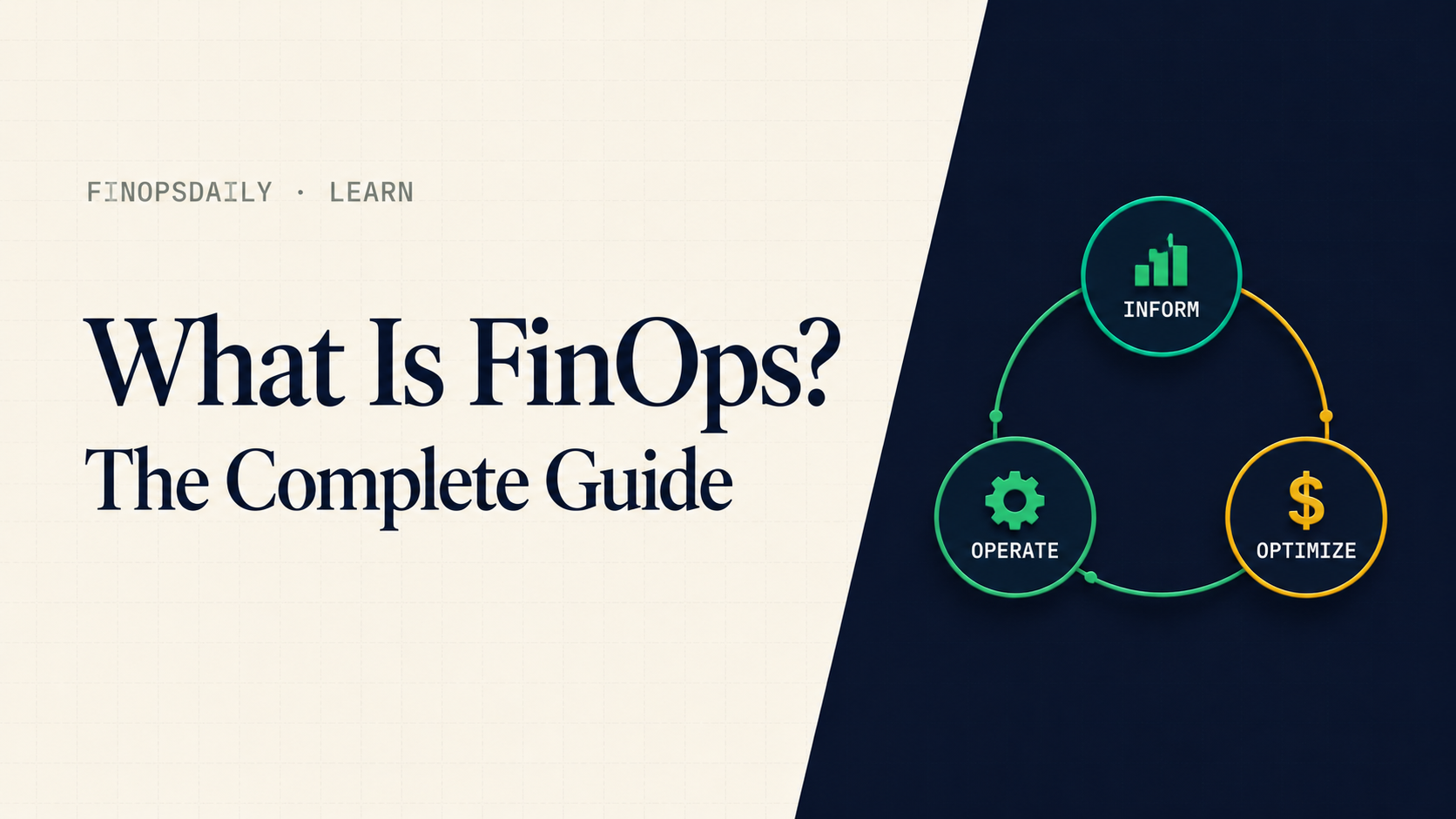
FinOps (short for Financial Operations) is a cloud financial management discipline that brings engineering, finance, and business teams together to manage cloud spending, increase accountability, and maximize the business value of every dollar spent in the cloud. Rather than simply cutting costs, FinOps helps organizations spend wisely and make faster, data-driven decisions about how they use the cloud.
If cloud cost optimization is the set of tactics that lower a bill, FinOps is the operating model and culture that makes those tactics happen continuously — with shared ownership across the people who spend the money and the people who account for it.
FinOps in brief
- Stands for: Financial Operations.
- Goal: maximize the business value of cloud spend, not just reduce it.
- Framework: three iterative phases — Inform, Optimize, Operate.
- Owned by: cross-functional teams, often reporting to the CTO or CIO.
- Applies to: AWS, Azure, GCP, Kubernetes, and increasingly AI, SaaS, and data center spend.
What does FinOps mean?
FinOps combines “Finance” and “DevOps,” and the name is deliberate. Just as DevOps broke down the wall between developers and operations, FinOps breaks down the wall between the people who use the cloud (engineers) and the people who pay for it (finance and leadership).
The core shift is cultural: in a FinOps practice, engineers see the cost consequences of their architectural choices, finance gets near-real-time visibility instead of month-end surprises, and everyone shares responsibility for spending wisely. Cost becomes a metric engineers optimize for — like performance or reliability — rather than someone else’s problem.
Crucially, FinOps is not just about spending less. A team might decide to spend more on cloud because it drives more revenue or ships a product faster. FinOps gives them the data to make that tradeoff deliberately, instead of discovering it on an invoice.
Why FinOps matters now
Cloud spending has become one of the largest and least predictable costs in modern business, and three forces have pushed FinOps from “nice to have” to essential:
- Cloud waste is the default. Without a deliberate practice, costs stay invisible until the bill arrives — by which point the chance to act has passed.
- The scope has expanded. FinOps in 2026 reaches well beyond cloud infrastructure to cover AI workloads, SaaS subscriptions, software licensing, and even data center spend — anywhere technology investment needs governance. AI in particular has made spend more variable and harder to predict, which makes a disciplined practice more valuable. See AI cost optimization.
- It’s now a strategic, board-level conversation. FinOps is increasingly expected to act as a strategic partner to leadership, connecting technology investment to business outcomes — not just trimming invoices. Notably, most FinOps practices today report into the CTO or CIO rather than the CFO, reflecting how technical the discipline has become.
For a snapshot of how the practice is evolving, see the State of FinOps 2026.
The FinOps framework
The FinOps Foundation maintains the open framework most practitioners follow. You don’t need every part of it to start, but understanding the shape helps. Three elements matter most.
The three phases: Inform, Optimize, Operate
FinOps runs as a continuous loop, not a linear project. Teams cycle through three phases repeatedly:
- Inform. Gain full visibility into who is spending what, where, and on which services. This covers tagging, cost allocation, dashboards, forecasting, and anomaly detection. It’s the foundation — you can’t manage what you can’t see.
- Optimize. Identify and act on opportunities to improve efficiency: rightsizing, eliminating waste, and applying commitment-based discounts.
- Operate. Build the ongoing processes, policies, and automation that keep costs in check — embedding cost awareness into everyday engineering and decision-making.
Organizations rarely sit neatly in one phase. Different teams, products, and business units often operate in different phases at the same time. Read more in the FinOps framework explained.
The six FinOps principles
The framework is grounded in six guiding principles:
- Teams need to collaborate.
- Decisions are driven by the business value of cloud.
- Everyone takes ownership of their cloud usage.
- FinOps data should be accessible and timely.
- A centralized team drives FinOps.
- Take advantage of the variable cost model of the cloud.
We unpack each one in the 6 FinOps principles.
The maturity model: Crawl, Walk, Run
You don’t jump straight to an advanced practice. FinOps uses a “Crawl, Walk, Run” model: start small with basic visibility and a few high-impact actions (Crawl), build repeatable processes (Walk), then automate and optimize at scale (Run). This lets organizations grow in scope and sophistication without trying to boil the ocean on day one. See the FinOps maturity model.
FinOps vs DevOps vs cloud cost management
These terms get muddled, so it’s worth being precise:
- Cloud cost management is the broad activity of monitoring and controlling cloud spend — often just reporting and budgeting.
- Cloud cost optimization is the technical work of actually lowering the bill.
- FinOps is the cultural operating model and framework that organizes both into a continuous, cross-functional practice with shared accountability.
It’s also distinct from DevOps, though it borrows the same collaborative spirit. We compare them directly in FinOps vs DevOps.
Who owns FinOps?
In most organizations a small centralized FinOps team (sometimes a “Cloud Center of Excellence”) drives the practice — but it succeeds only when engineering, finance, product, and leadership all participate. The central team provides tooling, data, and standards; the distributed teams own the costs they generate. For how to structure this, see how to build a FinOps team.
A related, practical decision is whether to use showback (showing teams their costs) or chargeback (billing teams for them). It shapes how much accountability the practice actually creates — see showback vs chargeback.
How to get started with FinOps
You can begin without buying anything or hiring a team:
- Inform first. Turn on cost allocation tags and build one shared dashboard so spend is visible by team and product.
- Set up anomaly alerts so cost spikes trigger a notification, not a month-end shock.
- Pick a few high-impact optimizations — delete obvious waste, rightsize the biggest offenders, and cover steady workloads with commitments.
- Assign ownership. Make sure every significant cost has a team that sees it.
- Make it routine. Add a recurring cost review to engineering cadence so optimization doesn’t decay.
For the tactical detail behind step 3, see the complete guide to cloud cost optimization.
FinOps careers and certification
As the discipline has grown, so has demand for people who practice it. FinOps roles — practitioner, engineer, analyst — are among the better-paid in cloud, precisely because they sit at the intersection of technical and financial skills. If you’re considering it as a career, see FinOps certification and the FinOps engineer role and salary.
Frequently asked questions
What is FinOps in simple terms?
FinOps is a way of working that brings engineering, finance, and business teams together to manage cloud spending and get the most value from it. It makes cloud cost a shared responsibility rather than a finance-only concern.
What does FinOps stand for?
FinOps stands for Financial Operations. The name echoes DevOps and signals the same idea: breaking down silos between teams — here, between those who use the cloud and those who pay for it.
What are the three phases of FinOps?
Inform (gain visibility into spend), Optimize (improve efficiency and apply discounts), and Operate (build ongoing processes and automation). Teams cycle through them continuously rather than completing them once.
Is FinOps only about cutting costs?
No. The goal is to maximize the business value of cloud spend. Sometimes that means spending more to ship faster or earn more — FinOps simply makes that decision deliberate and data-driven.
Who is responsible for FinOps?
A centralized FinOps team usually drives the practice, but it depends on collaboration from engineering, finance, product, and leadership. Most FinOps teams today report to the CTO or CIO.
How do I start doing FinOps?
Start with the Inform phase: tag and allocate costs, build a shared dashboard, and enable anomaly alerts. Then assign cost ownership and add a regular cost review to your engineering routine.
Written by the FinOpsDaily team. Last updated: 2026. Framework details follow the FinOps Foundation’s open framework; we summarize it in our own words and update as it evolves.


Pingback: FinOps Statistics (2026) – Key Data & Trends for Cloud Financial Management
Pingback: Cloud Cost Optimization: Strategies & 30-Day Plan