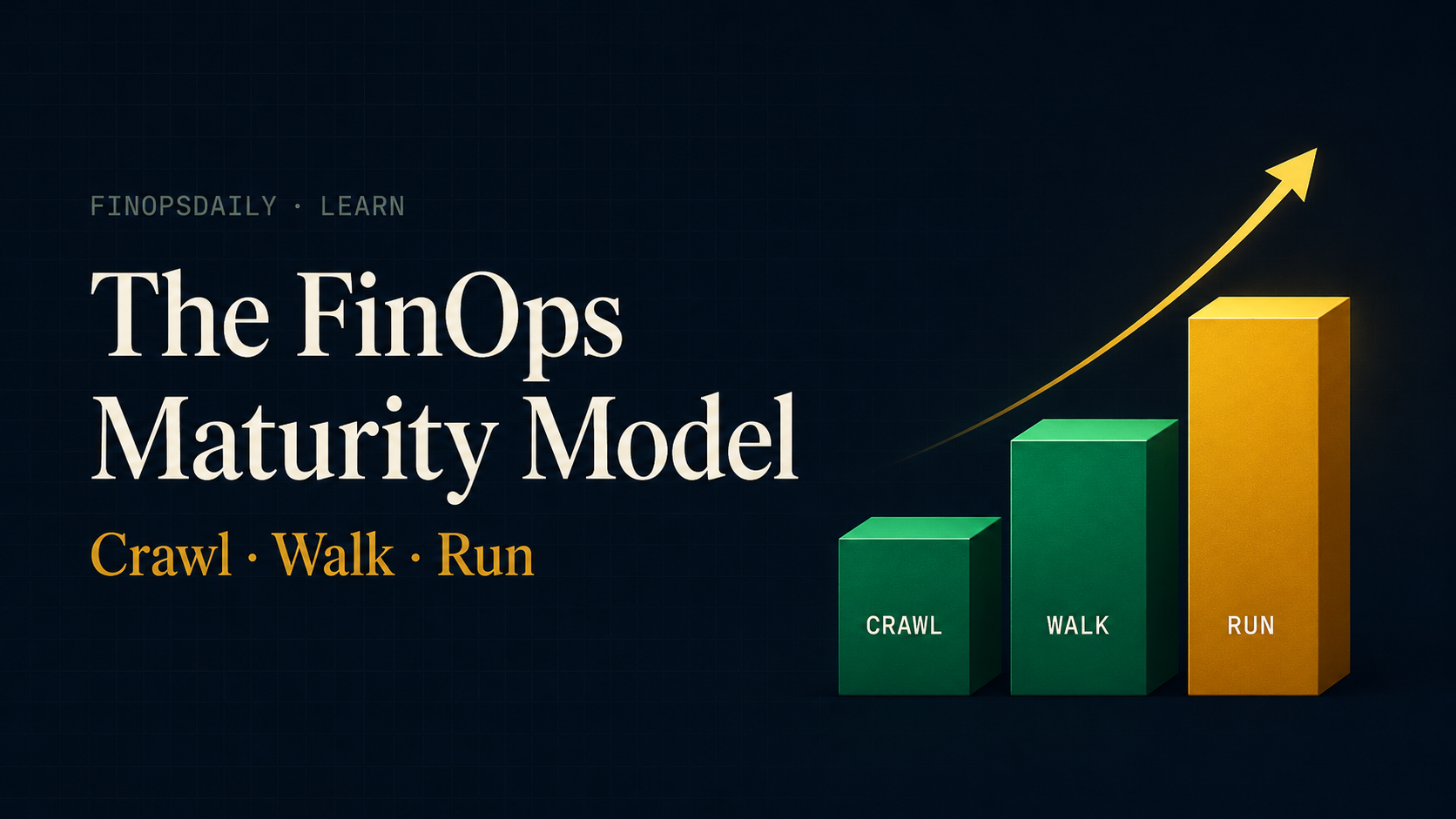
The FinOps maturity model describes how a cloud cost practice grows through three stages — Crawl, Walk, and Run — starting with basic visibility and a few high-impact actions, then building repeatable processes, and finally automating and optimizing at scale. It exists because no organization can jump straight to an advanced practice; you build foundational skills before tackling complex ones.
The model is part of the FinOps framework, and it’s the most useful tool for answering a practical question: where are we now, and what should we do next?
The three stages at a glance
- Crawl — limited visibility, a few quick wins, mostly manual and reactive.
- Walk — costs allocated and owned, repeatable processes, some automation.
- Run — cost is embedded in engineering culture, highly automated, near-real-time, proactive.
Why a maturity model?
Cloud environments are fluid, and so are teams. The maturity model gives you a realistic, staged path instead of an intimidating all-or-nothing target. It also sets honest expectations: a company just starting out shouldn’t compare itself to a mature practice with dedicated tooling and a full team. You progress by deepening each capability over time, not by flipping a switch.
Importantly, maturity isn’t uniform across an organization. You might be at “Run” for compute rightsizing but still “Crawl” for Kubernetes or AI cost. That’s normal — assess each area on its own.
Crawl: getting started
At the Crawl stage, an organization is just beginning to gain control. Visibility is partial, processes are manual, and action tends to be reactive — someone notices a big bill and scrambles to respond.
What it looks like:
- Cost data exists but is incomplete or inconsistently tagged.
- Only a few people look at spend, usually in finance.
- Optimization happens occasionally, as one-off cleanups.
- Few or no cost allocation or ownership rules.
What to focus on: the basics of the Inform phase. Implement a tagging strategy, build one shared cost dashboard, set up anomaly alerts, and tackle the obvious waste — idle resources and oversized instances. These few moves often deliver the largest percentage savings of the whole journey. The tactics are in cloud cost optimization.
Walk: building the practice
At the Walk stage, FinOps has become a real, repeatable practice rather than a fire drill. Most costs are allocated to owners, processes are documented, and the organization acts on optimization opportunities consistently.
What it looks like:
- Most spend is tagged and allocated to teams or products.
- Engineering teams can see their own costs and feel some ownership.
- Forecasting and budgeting are in place.
- Commitments (Savings Plans, Reservations, CUDs) are managed deliberately.
- Some optimization is automated; some is still manual.
What to focus on: spreading ownership and adding capabilities. Move from showback toward chargeback if it fits your culture, formalize forecasting, and start automating routine optimization. Establishing a centralized team to drive this — per the FinOps principles — is usually what unlocks the next stage. See how to build a FinOps team.
Run: optimizing at scale
At the Run stage, FinOps is woven into how the organization operates. Cost is a first-class engineering metric, decisions are data-driven and proactive, and much of the work is automated. Teams consider cost at design time rather than cleaning up afterward.
What it looks like:
- Near-real-time cost visibility, available where engineers work.
- Cost ownership is cultural — teams optimize without being told.
- Heavy automation: anomaly response, rightsizing, and commitment management run continuously.
- “Shift-left” cost governance — costs are estimated and guarded at the design and pull-request stage.
- Unit economics (cost per customer, per feature) drive business decisions.
What to focus on: refinement and frontier areas. At Run, the basics are handled, so attention shifts to harder problems — Kubernetes allocation, AI and GPU unit economics, and connecting cost data to business strategy at the executive level.
How to assess and advance your maturity
A simple way to gauge where you stand, per area:
- Visibility — can you see who spends what, and how current is the data?
- Allocation — is spend tied to owners, or is it a shared blind spot?
- Optimization — is it continuous and partly automated, or occasional and manual?
- Culture — do engineers consider cost by default, or only when prompted?
Pick the lowest area and improve it next — your practice is only as mature as its weakest capability. Then re-run the Inform → Optimize → Operate loop with that capability strengthened.
Frequently asked questions
What is the FinOps maturity model? It’s a staged model — Crawl, Walk, Run — describing how a cloud cost practice grows from basic, manual visibility to a fully automated, culturally embedded discipline.
What are the stages of FinOps maturity? Three: Crawl (getting started with basic visibility and quick wins), Walk (repeatable processes and cost ownership), and Run (automation, near-real-time data, and cost-aware engineering culture).
How do I know what FinOps maturity level I’m at? Assess your visibility, cost allocation, optimization, and culture. If data is incomplete and action is reactive, you’re at Crawl; if costs are owned and processes are repeatable, Walk; if cost is automated and embedded in engineering, Run.
Do you have to be at the Run stage to succeed? No. Most of the largest percentage savings come during Crawl and Walk. Run is about sustaining and refining at scale, not a prerequisite for results.
Can different teams be at different maturity levels? Yes, and they usually are. You might be mature in compute optimization but early in Kubernetes or AI cost. Assess and advance each area independently.
Written by the FinOpsDaily team. Last updated: 2026. The Crawl/Walk/Run model follows the FinOps Foundation’s open framework; explanations and guidance are our own.