The FinOps Framework is the open, community-maintained model that defines how organizations practice cloud financial management — using a shared language of principles, personas, phases, and capabilities so engineering, finance, and business teams can manage cloud spending the same way. Maintained by the FinOps Foundation, it gives teams a common map for turning chaotic cloud bills into a disciplined, value-driven practice.
If you’re new to the discipline itself, start with what is FinOps. This guide goes a level deeper into the framework’s structure and how to actually use it.
At a glance
- The framework is built from a few core building blocks: principles, personas, phases, maturity, and capabilities.
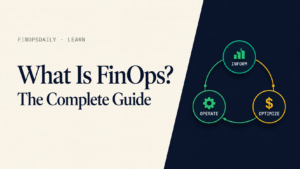
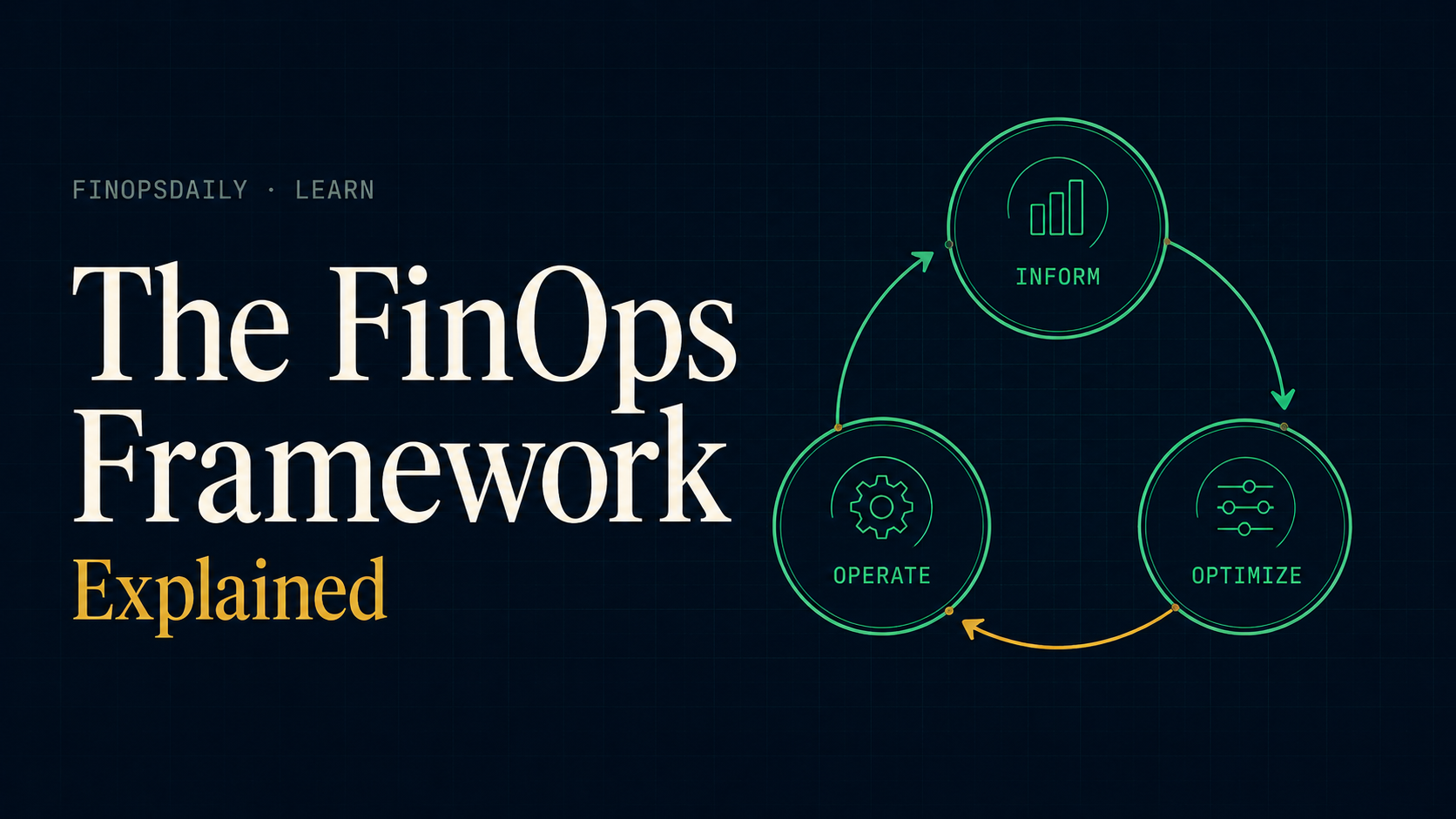
- Its engine is a continuous loop of three phases: Inform → Optimize → Operate.
- In 2026 the framework’s scope expanded beyond cloud to cover AI, SaaS, licensing, and data center spend.
- You don’t adopt all of it at once — you grow into it (see the maturity model).
What is the FinOps Framework?
The FinOps Framework is essentially a standard way of doing cloud financial management. Before it existed, every company invented its own approach, its own vocabulary, and its own definition of “done.” The framework provides a common reference — so a practitioner moving between companies, or a vendor building a tool, can speak the same language.
It is intentionally an operating model rather than a rigid checklist. It describes how data flows, how ownership is modeled, how decisions get made, and how value is measured — and lets each organization apply that to its own environment.
The building blocks of the framework
The framework is made up of several interlocking parts. You don’t need to memorize them, but knowing the shape helps you navigate the official material:
- Principles — the values that guide every decision. There are six. See the 6 FinOps principles.
- Personas — the different roles that participate: the FinOps practitioner, plus engineering, finance, leadership, product, and procurement.
- Phases — the continuous cycle of work: Inform, Optimize, Operate.
- Maturity — how sophisticated your practice is, expressed as Crawl, Walk, Run.
- Domains and Capabilities — the actual functional activities, such as cost allocation, forecasting, anomaly management, rate optimization, and workload optimization.
- Scopes / Technology Categories — what the practice covers (public cloud, SaaS, data center, AI, and more).
The two pieces you’ll use most day to day are the phases and the capabilities.
The three phases: Inform, Optimize, Operate
The framework’s beating heart is a feedback loop. Teams move through it continuously — not as a one-time project that finishes.
Inform
The foundation. This phase is about visibility: knowing who is spending what, where, and on which services. The work here includes tagging, cost allocation, building dashboards, forecasting, and anomaly detection. Without a solid Inform phase, every later action is guesswork. As the saying goes, you can’t manage what you can’t measure.
Optimize
Once you can see clearly, you act. The Optimize phase covers the efficiency work: rightsizing over-provisioned resources, eliminating waste, and applying commitment-based discounts to steady workloads. This is where most of the headline savings come from — see cloud cost optimization for the tactical detail.
Operate
The phase that makes it stick. Operate is about building the ongoing processes, policies, governance, and automation that keep costs in check over time — and embedding cost awareness into everyday engineering decisions. Mature teams “shift left,” estimating and governing costs at the design and pull-request stage rather than reacting after the spend has already happened.
A common misconception is that these are sequential stages you graduate from. In reality, different teams and workloads sit in different phases at the same time, and everyone cycles through all three repeatedly.
Domains and capabilities: the actual work
Underneath the phases, the framework organizes the concrete activities into capabilities — the specific things a FinOps team does. These include cost allocation, data ingestion and normalization, forecasting and budgeting, anomaly management, rate optimization (commitments and discounts), workload (usage) optimization, and establishing a FinOps culture and decision-making practice.
You can think of phases as when you do something and capabilities as what you do. A maturing practice gradually adds capabilities and performs each one more rigorously.
Scopes: FinOps beyond the cloud
One of the biggest shifts in recent years is that the framework no longer applies only to public cloud. Its scope now spans SaaS subscriptions, software licensing, private cloud and data center spend, and — most importantly — AI workloads. AI has made technology spend more variable and harder to forecast, so the same discipline of visibility, optimization, and accountability now extends to GPU and model costs. See AI cost optimization.
This expansion also reflects FinOps becoming a more strategic, executive-level function — connecting all technology investment to business outcomes, not just trimming a cloud invoice.
How to use the framework in practice
You don’t implement the framework by reading it cover to cover. A practical path:
- Locate yourself. Use the maturity model to honestly assess where you are (most teams start at Crawl).
- Lead with Inform. Get clean cost allocation and one shared dashboard before anything else.
- Add a few capabilities at a time. Don’t try to do everything — pick the highest-impact activities for your stage.
- Assign personas. Make sure each role knows its part, and that a central team drives the practice. See how to build a FinOps team.
- Iterate. Run the Inform→Optimize→Operate loop on a regular cadence so the practice improves continuously.
Frequently asked questions
What is the FinOps Framework?
It’s the open, community-maintained operating model for cloud financial management. It defines a shared set of principles, personas, phases, and capabilities so teams can manage cloud spend in a consistent, value-driven way.
What are the phases of the FinOps Framework?
Inform (gain visibility), Optimize (improve efficiency and apply discounts), and Operate (build ongoing processes and automation). Teams cycle through them continuously rather than completing them once.
Who maintains the FinOps Framework?
The FinOps Foundation, a community of practitioners, maintains it as an open framework available for anyone to adopt and adapt.
Does the FinOps Framework only apply to cloud?
No longer. Its scope has expanded to cover SaaS, software licensing, data center spend, and AI workloads — anywhere technology investment needs governance and accountability.
How is the framework different from the FinOps principles?
The principles are the underlying values; the framework is the full operating model — principles plus personas, phases, maturity, and capabilities — that puts those values into practice.
Written by the FinOpsDaily team. Last updated: 2026. We summarize the FinOps Foundation’s open framework in our own words and update this guide as the framework evolves.