
Last updated: September 8, 2026
In brief: If you’re evaluating CloudHealth alternatives, this guide compares the top FinOps tools on multi‑cloud coverage, actionability, pricing transparency, and AI‑cost readiness—covering Cloudability, Finout, CloudZero, Vantage, nOps, Amnic, and others. This post may contain affiliate/partner links. If you buy or sign up through them, we may earn a commission at no extra cost to you.
Why teams seek CloudHealth alternatives
CloudHealth by Broadcom remains a mature multi‑cloud FinOps platform, but its pricing (typically a percentage of cloud spend) and enterprise‑only sales motion are increasingly misaligned with fast‑moving crews and mid‑market budgets ([trycloudios.com](https://trycloudios.com/blog/cloudhealth-alternatives-2026?utm_source=openai)). Onboarding time measured in weeks and uncertainty following repeated ownership/branding transitions have driven many FinOps teams to look for modern replacements ([trycloudios.com](https://trycloudios.com/blog/cloudhealth-alternatives-2026?utm_source=openai)).
How do alternatives compare?
Some alternatives excel at allocation and visibility, others at automation or AI cost attribution. Here’s a feature breakdown:
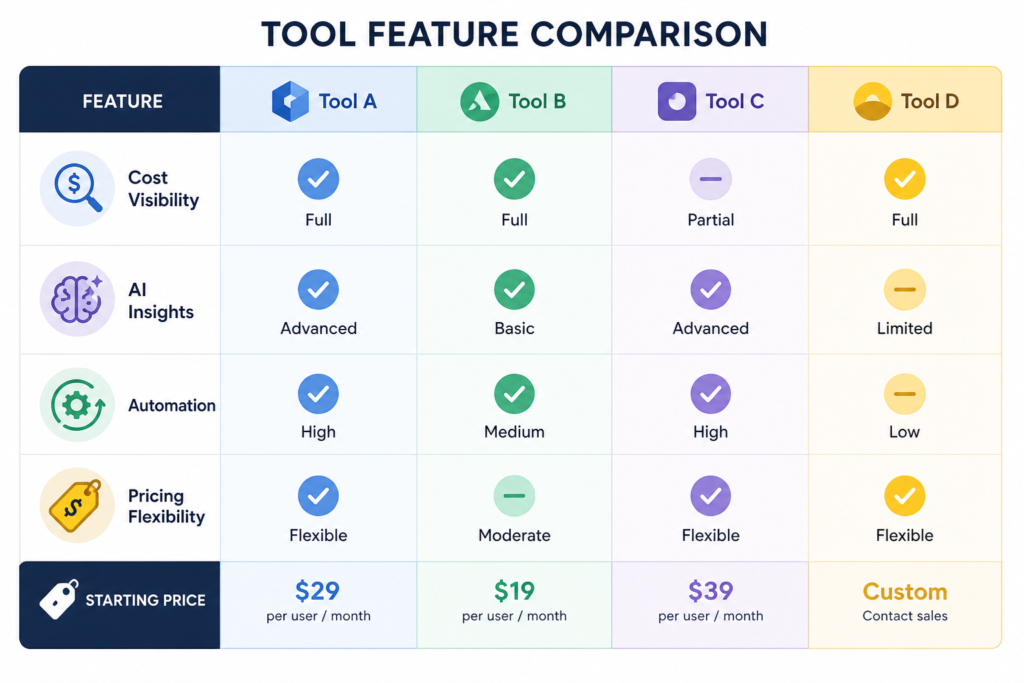
| Tool | Best for | Cloud Coverage | AI/Unit Economics | Pricing Model | Free Tier / Trial |
|---|---|---|---|---|---|
| Amnic | Unified multi‑cloud + AI agents | AWS, Azure, GCP, Alibaba, Oracle, Kubernetes | Roll‑out on Bedrock, OpenAI, Anthropic | 0.25–1% of spend | 1‑month trial |
| Cloudability (IBM) | Enterprise chargeback/showback & TBM | AWS, Azure, GCP | Custom ingest; not native | Enterprise quote | None |
| CloudZero | Unit economics: cost per feature/customer | AWS, Azure, GCP | AnyCost API | %‑of‑spend, quote | None |
| Vantage | Fast onboarding, SaaS integrations | Multi‑cloud + 30+ services | OpenAI & Anthropic spend | Fixed tiers ($0–$200/mo) | Free tier + trial |
| Finout | Code‑free allocation across sources | AWS, Azure, GCP, Kubernetes, SaaS | N/A (MegaBill view) | Flat annual fee (quote) | Trial available |
| nOps | AWS automation: commitments & rightsizing | AWS dominant | ML compute cost | Visibility free; optimization share‑of‑savings | Yes |
Sources: Varcio Cloud (Amnic, FinOps Co‑Pilot, Kubecost), CloudQuell comparison (Cloudability, Finout, CloudZero), Amnic ranking list, Finops.qa accuracy test notes ([varcio.com](https://varcio.com/blog/finops-copilot-vs-cloudhealth-vs-kubecost?utm_source=openai)).
Detailed tool breakdown
Amnic
Amnic pairs broad multi‑cloud visibility (AWS, Azure, GCP, Oracle, Alibaba, Kubernetes) with approximate AI‑cost intelligence via agent‑based insights. Reported verified savings of 20‑50% on targeted cost lines ([amnic.com](https://amnic.com/blogs/cloudhealth-alternatives?utm_source=openai)). Pricing is modest (0.25–1% of spend), with a 30‑day trial available—a fast read‑only path to value, ideal for AI‑heavy teams.
Cloudability (IBM)
A mature platform for enterprise FinOps with strength in chargeback/showback, RI and savings plan modeling, budgeting and BI exports ([amnic.com](https://amnic.com/blogs/cloudhealth-alternatives?utm_source=openai)). Designed for centralized finance teams, pricing is enterprise‑negotiated with no self‑serve or trial. Best when FinOps needs align with broader ITFM/TBM initiatives.
CloudZero
Specializes in cost per unit/feature and unit economics, spanning multi‑cloud and AI/SaaS spend via AnyCost API ([cloudquell.com](https://www.cloudquell.com/compare/cloudhealth-alternatives/?utm_source=openai)). Structured on percentage‑of‑spend contracts (median ~$78K/year), positioned for mid‑market to enterprise. No free tier or trial, but strong narrative on actionable cost insights ([trycloudios.com](https://trycloudios.com/blog/cloudhealth-alternatives-2026?utm_source=openai)).
Vantage
Self‑serve friendly: free tier (≤$2.5K/mo tracked), up to ~$200/month after; onboarding often shows spend insights within hours ([amnic.com](https://amnic.com/blogs/cloudhealth-alternatives?utm_source=openai)). Provides 30+ integrations, including SaaS, plus AI/LLM cost tracking. Best for engineering‑centric teams wanting fast insights and price transparency.
Finout
Offers code‑free “virtual tagging” across cloud, K8s, SaaS, LLM, Snowflake, delivering 100% allocation in a unified bill (MegaBill) ([cloudquell.com](https://www.cloudquell.com/compare/cloudhealth-alternatives/?utm_source=openai)). Flat annual fee (quote) model aligns with predictable budgets. Good for teams needing granular allocation without instrumentation.
nOps
Focused on AWS cost optimization: automated rightsizing, savings plans, Karpenter scheduling, anomaly alerts, cross‑account visibility, ML/AI compute optimization on AWS ([amnic.com](https://amnic.com/blogs/cloudhealth-alternatives?utm_source=openai)). Visibility is free; optimization fees are a share of realized savings. Ideal for AWS‑centric engineering teams preferring pay‑as‑you‑save model.
How to choose the right tool
- Define your priority: allocation visibility, AI‑cost tracking, automation, pricing model.
- Match the tool to your maturity and spend scale:
- Enterprise governance → Cloudability
- Fast, self‑serve visibility → Vantage
- Unit economics & AI cost → CloudZero or Amnic
- Granular allocation without tags → Finout
- AWS automation‑first → nOps
- Test read‑only on your billing data for 30 days where possible—Amnic, Vantage, nOps offer trials/free tiers ([amnic.com](https://amnic.com/blogs/cloudhealth-alternatives?utm_source=openai)).
- Consider a hybrid approach if Kubernetes spend is large: pair a multi‑cloud tool (Vantage or Cloudability) with Kubecost for pod‑level accuracy ([finops.qa](https://finops.qa/blog/finops-tools-comparison-2026/?utm_source=openai)).
Comparison table summary
| Scenario | Recommended tool(s) |
|---|---|
| Enterprise governance, TBM alignment | Cloudability |
| Fast setup, transparent pricing | Vantage |
| Cost per feature/customer, AI spend | CloudZero or Amnic |
| Granular allocation without tagging | Finout |
| AWS‑automation and commitment management | nOps |
| Kubernetes‑heavy environments | Vantage or Cloudability + Kubecost hybrid |
Frequently Asked Questions
Which tool is the best overall alternative to CloudHealth?
There is no one single “best.” Cloudability leads in enterprise governance, Vantage leads in fast time‑to‑value with transparent pricing, Amnic and CloudZero shine in AI cost and unit economics, Finout excels in allocation without tagging, and nOps automates AWS cost. Choose based on your dominant need.
Do any alternatives offer self‑serve pricing?
Yes—Vantage offers a free tier and fixed price plans; nOps provides free visibility; Amnic includes a trial; Finout and Cloudability require quotes. CloudZero is percentage‑based and sales‑led.
What if Kubernetes cost accuracy matters most?
Kubecost (or its free variant OpenCost) specializes in pod and namespace cost. A hybrid approach—Vantage or Cloudability for cloud + Kubecost for Kubernetes—is common ([finops.qa](https://finops.qa/blog/finops-tools-comparison-2026/?utm_source=openai)).
Will tool costs scale as my cloud spend grows?
Yes. Percentage‑of‑spend tools like CloudZero, Amnic, Cloudability will cost more as you grow. Fixed‑price and tiered models (Vantage, nOps optimization fees, Finout) offer more predictability.
How quickly can I test one of these tools?
Amnic, Vantage, and nOps support fast onboarding—some within hours or days. Others require enterprise procurement cycles.
Where this fits in your FinOps ecosystem
Choosing the right alternative depends on context. For long‑term alignment with FinOps maturity, you might start with Vantage for fast visibility, layer in Kubecost for accurate Kubernetes attribution, then graduate to Amnic or CloudZero as AI costs dominate. Each tool fills a distinct gap—this comparison helps map your journey. Also see our broader suite of tools on Best FinOps tools.
About the Author: Nhon Dang is a cloud infrastructure and operations professional with over 10 years of hands‑on experience in cloud services, infrastructure, and business operations. He’s written extensively on cloud cost management, DevOps, Kubernetes, and FinOps, blending real‑world experience with technical clarity.