
Last updated: September 18, 2026
FinOps for AI means treating AI spending—especially from agentic workflows and GenAI—not just as tokens or GPU hours, but in business outcomes, with governance, attribution, and continuous control built in from day one.
Why is AI cost management different for agentic and GenAI workloads?
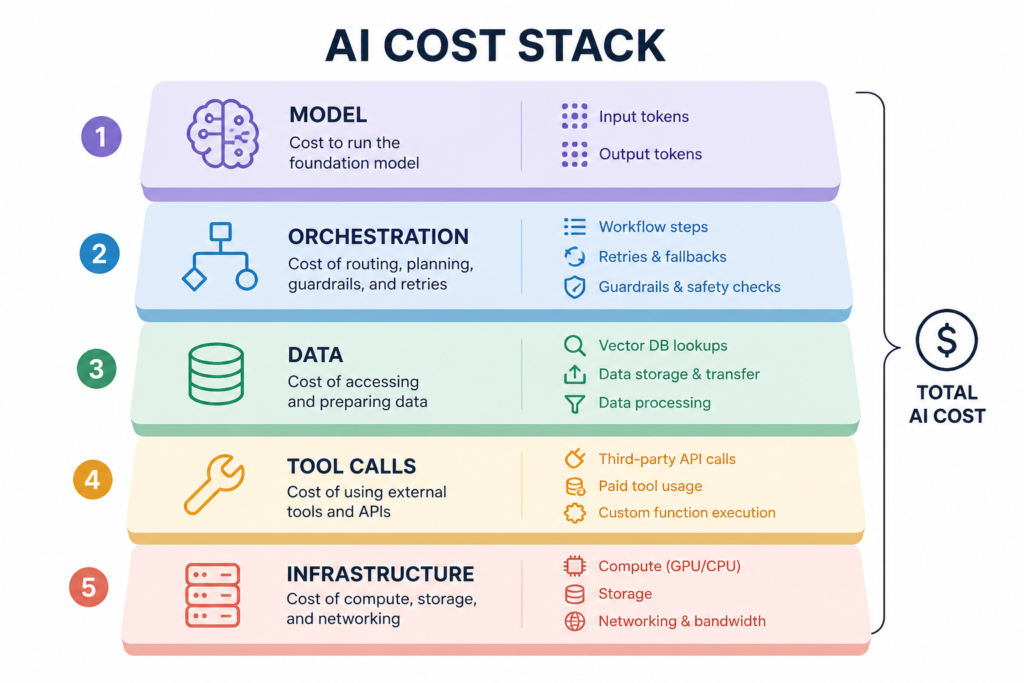
AI cost behavior diverges sharply from traditional cloud or even prompt-based LLM use. Agentic AI workflows may trigger multiple chained model calls, external tool invocations, retries, data lookups and orchestration steps for a single user task—dramatically inflating cost unpredictably ([techtarget.com](https://www.techtarget.com/ai/tip/How-to-apply-FinOps-to-optimize-agentic-AI-costs?utm_source=openai)).
GenAI APIs charge per token, but outcome value varies. More tokens don’t always mean better results—a key insight from research showing high token consumption doesn’t always correlate with accuracy, and can vary 30× between runs ([arxiv.org](https://arxiv.org/abs/2604.22750?utm_source=openai)).
What’s the real unit of cost in FinOps for AI?
Instead of “tokens” or “GPU hours,” FinOps for AI shifts to “cost per business outcome,” like support case resolved, code merged, report generated ([techtarget.com](https://www.techtarget.com/ai/tip/How-to-apply-FinOps-to-optimize-agentic-AI-costs?utm_source=openai)). It makes cost meaningful across teams and aligns expenditure with value.
How do current practice models apply?
Several AI cost frameworks have emerged:
- Agentic AI FinOps: Emphasizes spend visibility per agent and per workflow, optimizing model use and embedding step limits early in design ([sumatogroup.com](https://sumatogroup.com/en/insights/blog/finops-ia-agentica?utm_source=openai)).
- FinOps for LLM & GenAI: Proposes breaking down token spend by input vs. output vs. cache vs. retries, across workloads with different latency, quality, and ownership ([finopsllm.com](https://finopsllm.com/research/finops-for-llm?utm_source=openai)).
- Comprehensive AI FinOps: Combines visibility, budgeting, anomaly detection, forecasting, and even automation of actions using AI for spend control ([n-ix.com](https://www.n-ix.com/finops-for-ai/?utm_source=openai)).
How do you implement FinOps for AI effectively?
- Instrument full-stack visibility: Track every call—model, tool, embeddings, storage, retries—with metadata tagging by product, workflow, business unit, agent, model, environment ([techtarget.com](https://www.techtarget.com/ai/tip/How-to-apply-FinOps-to-optimize-agentic-AI-costs?utm_source=openai)). FOCUS standard can help normalize billing across layers ([techtarget.com](https://www.techtarget.com/ai/tip/How-to-apply-FinOps-to-optimize-agentic-AI-costs?utm_source=openai)).
- Attribute costs to outcomes: Organize spend around workflows like “support summary,” “code change,” “document review,” not merely APIs or endpoints ([techtarget.com](https://www.techtarget.com/ai/tip/How-to-apply-FinOps-to-optimize-agentic-AI-costs?utm_source=openai)).
- Optimize model routing & context usage: Use smaller models for classification or extraction; reserve expensive frontier models for complex reasoning. Cache embeddings, compress prompts, batch low-latency tasks, and cap retries and step counts ([techtarget.com](https://www.techtarget.com/ai/tip/How-to-apply-FinOps-to-optimize-agentic-AI-costs?utm_source=openai)).
- Embed operational controls: Set hard limits on step counts, context length, tool budgets; include approval gates and escalation points to avoid runaway workflows ([techtarget.com](https://www.techtarget.com/ai/tip/How-to-apply-FinOps-to-optimize-agentic-AI-costs?utm_source=openai)).
- Use AI to manage AI costs: Implement anomaly detection, spending forecasts, automated reports, and even AI-driven actions like route optimization or spend throttling ([n-ix.com](https://www.n-ix.com/finops-for-ai/?utm_source=openai)).
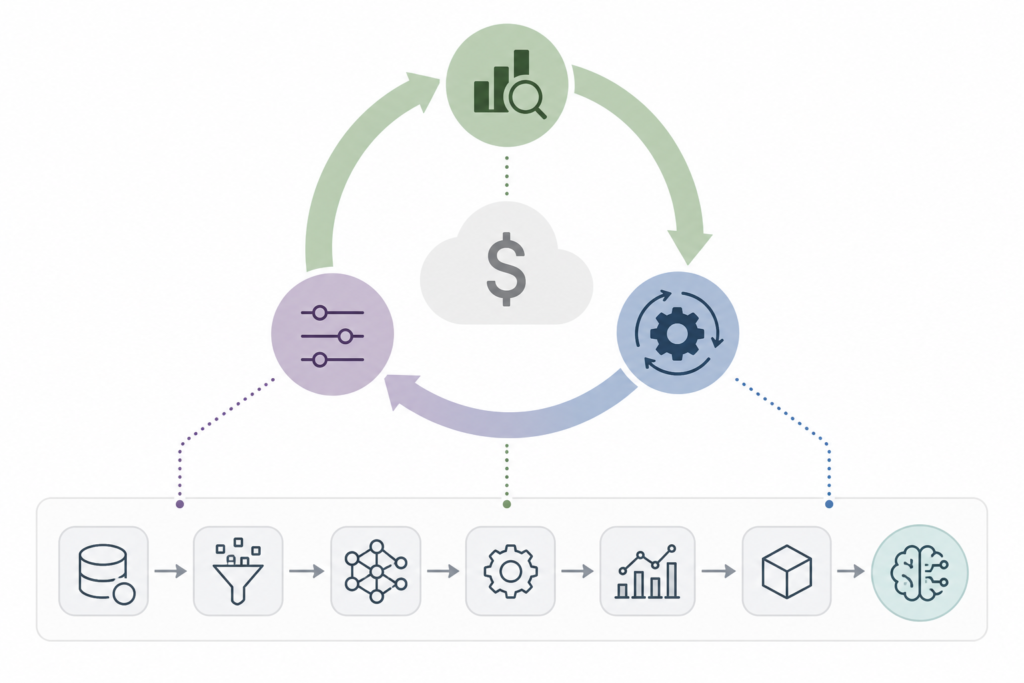
- Operate continuously: Move from quarterly cleanup to continuous cost governance—budgets, alerts, monthly reviews, engineering scorecards, post-mortems, tracing and monitoring aligned with outcome cost metrics ([techtarget.com](https://www.techtarget.com/ai/tip/How-to-apply-FinOps-to-optimize-agentic-AI-costs?utm_source=openai)).
How does this differ from traditional FinOps?
| Traditional FinOps | FinOps for AI |
|---|---|
| Cost per VM, storage, compute hour | Cost per completed business outcome (by workflow) |
| Reactive billing review | Continuous, real-time controls and anomaly detection |
| Tagging cloud infra | Tagging at agent, task, model, tool, and step levels |
| Optimizing infrastructure rates | Model routing, prompt context, tool call reduction |
What concrete example illustrates the numbers?
Consider a customer support agentic workflow that: a) retrieves customer history via vector search (50k tokens), b) drafts a reply (75k tokens), c) validates policy compliance (10k tokens), d) retries on errors (20k tokens), e) updates CRM (API call), f) logs outcome (storage + compute). Assuming model pricing of $0.0001 per token (placeholder; verify actual rates), that’s around $15 per task—plus infrastructure, embedding DB, tool calls, retries = ~$20–25. If successful resolutions drop repeat touches, cost per resolved case may be far lower than manual handling costs. Set by design: smaller models for retrieval/classification, cache common histories, cap retries to 1, batch similarly timed replies to bring unit cost down. [verify_before_publish]
How to link into our broader AI cost optimization strategy
This guide slots into the wider AI cost optimization hub strategy. For teams exploring tool-assisted agentic FinOps, check emerging platforms like Finout’s token-level allocation, Pointfive’s unit-economics support, or open-source control-plane layers ([reddit.com](https://www.reddit.com/r/FinOps/comments/1u0uclb/how_are_people_managing_ai_costs/?utm_source=openai)).
Frequently Asked Questions
- What is FinOps for AI? It’s the adaptation of FinOps principles—visibility, attribution, optimization, operating cadence—to AI workloads, where cost drivers include models, tokens, agents, tools, and outcome flows rather than just infrastructure.
- Why is “cost per outcome” better than cost per token? Outcome-based metrics align spending with business value, reduce runaway spending on unproductive loops, and help prioritize workflows by ROI.
- How do you track costs across agentic workflows? Use metadata tagging, trace individual task execution, link model calls, tool invocations, retries and embedding operations under a cost record per outcome. FOCUS spec helps normalize across vendors.
- Which optimizations give the biggest savings? Model routing (tiered models), prompt and context compression, caching repeated data, batching, and retry limits—especially where workflows are bursty or multi-step.
- Can AI tools manage AI FinOps? Yes. AI-driven anomaly detection, forecast models, and even automated cost controls are emerging as effective ways to scale governance without blocking innovation.
- How often should FinOps for AI reviews happen? Continuous—budgets, alerts, monthly reviews, and post-mortems aligned to engineering and business cycles are best practices.
- What’s unique about agentic AI costs? Their stochastic and multi-step nature means single tasks may multiply costs unpredictably through retries, branching, tool calls—often 10×–100× more than prompt APIs.
- How does this fit with traditional cloud FinOps? It’s a superset that uses many of the same frameworks but embeds them deeper into AI-specific constructs like models, tokens, agents, and orchestration steps.
About the Author
Nhon Dang is a cloud infrastructure and operations professional with over 10 years of hands-on experience in cloud services, infrastructure, and business operations. His expertise spans Kubernetes, managed databases, cloud GPU infrastructure, and distributed systems. He writes practical, credible, experience-driven guidance that helps engineers and businesses optimize cloud and AI operations.