
To reduce OpenAI API cost effectively, start by tracking what you’re spending, then optimize prompts, models, and workflows—and enforce spend controls to lock in savings.
Last updated: September 4, 2026
How do I understand what’s driving my OpenAI API bill?
Start by reviewing the Usage Dashboard or exporting detailed cost data via CSV. This lets you identify high-cost models, heavy users, or features inflating spend. OpenAI lets you filter usage by project or user and view token-level detail—then export transactions grouped by line item for exact tracking.([help.openai.com](https://help.openai.com/en/articles/10478918-reviewing-api-usage-and-costs))
What prompt-level tweaks cut token waste?
Prompts are where cost starts. Each extra token counts.
- Trim system prompts: remove redundancy, whitespace, and example repetition.([help.openai.com](https://help.openai.com/en/articles/6891753?utm_source=openai))
- Set reasonable
max_tokens—output isn’t free. Match the expected response length.([help.openai.com](https://help.openai.com/en/articles/6891753?utm_source=openai)) - Use structured output (JSON or function-calling) to eliminate conversational fluff.([blog.oberhahn.com](https://blog.oberhahn.com/nine-ways-to-reduce-openai-api-costs-without-slowing-down/?utm_source=openai))
- Enable prompt caching—identical requests can cost as little as ~10% of full rate.([respan.ai](https://www.respan.ai/articles/how-to-reduce-openai-api-costs?utm_source=openai))
Can selecting different models cut cost without reducing quality?
Yes—match task complexity to the simplest capable model.
- Route simple tasks (e.g., classification) to smaller models, reserve top-tier for complex reasoning.([blog.oberhahn.com](https://blog.oberhahn.com/nine-ways-to-reduce-openai-api-costs-without-slowing-down/?utm_source=openai))
- Test smaller versions like gpt‑5.4‑nano or mini in place of expensive models. Many workflows perform well on them at much lower cost.([community.openai.com](https://community.openai.com/t/how-to-reduce-the-cost-of-api-usage/1379330?utm_source=openai))
- Batch API for asynchronous workloads—costs about 50% lower than live calls.([developer-openai-com.sitemirror.store](https://developer-openai-com.sitemirror.store/api/docs/guides/cost-optimization/?utm_source=openai))
- Use flex processing for non-production tasks (evaluations, data prep) where slower response is acceptable.([developer-openai-com.sitemirror.store](https://developer-openai-com.sitemirror.store/api/docs/guides/cost-optimization/?utm_source=openai))
How do you avoid needless retries and loops that inflate cost?
Clear instructions and stopping conditions reduce repetition and retries.
- Define when to stop—e.g., output ends when you see
[DONE]or specific token limit. - Cache semantics at gateway level so repeated queries don’t hit the API unnecessarily.([respan.ai](https://www.respan.ai/articles/how-to-reduce-openai-api-costs?utm_source=openai))
- Use structured response formats to reduce retry rates from ~5–10% down to under 1%.([respan.ai](https://www.respan.ai/articles/how-to-reduce-openai-api-costs?utm_source=openai))
How can your architecture help reduce costs over time?
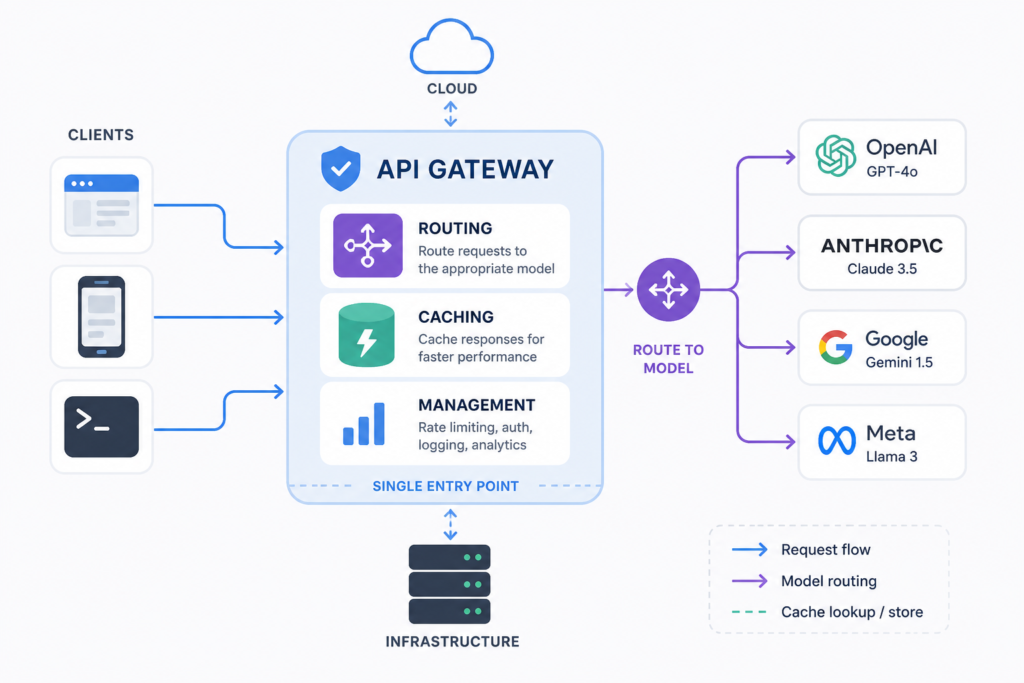
Build an API gateway to enable routing, caching, monitoring, and model switching.
- Implement semantic caching: check cache before hitting API.([respan.ai](https://www.respan.ai/articles/how-to-reduce-openai-api-costs?utm_source=openai))
- Route queries by complexity: simple tasks to small models, complex ones to big models.([blog.oberhahn.com](https://blog.oberhahn.com/nine-ways-to-reduce-openai-api-costs-without-slowing-down/?utm_source=openai))
- Log estimated cost per request (tokens × rate) to attribute spend per feature or client internally.([reddit.com](https://www.reddit.com/r/LLMDevs/comments/1vq6cid/our_openai_bill_tells_us_what_we_spent_not_who/?utm_source=openai))
Should spend controls and limits be used to guard against surprises?
Yes—set hard caps and alerts before your budget runs away.
- Use built-in spend limits at organization or project level; they stop API traffic when hit.([help-lb.openai.com](https://help-lb.openai.com/en/articles/6614457?utm_source=openai))
- Monitor rate and usage limits; configure exponential backoff to handle 429 errors gracefully.([help-lb.openai.com](https://help-lb.openai.com/en/articles/5955604?utm_source=openai))
- Use prepaid billing with auto-recharge thresholds to control cash flow—but note credits expire in a year.([help-lb.openai.com](https://help-lb.openai.com/en/articles/8264644?utm_source=openai))
How do I track cost attribution across features or teams?
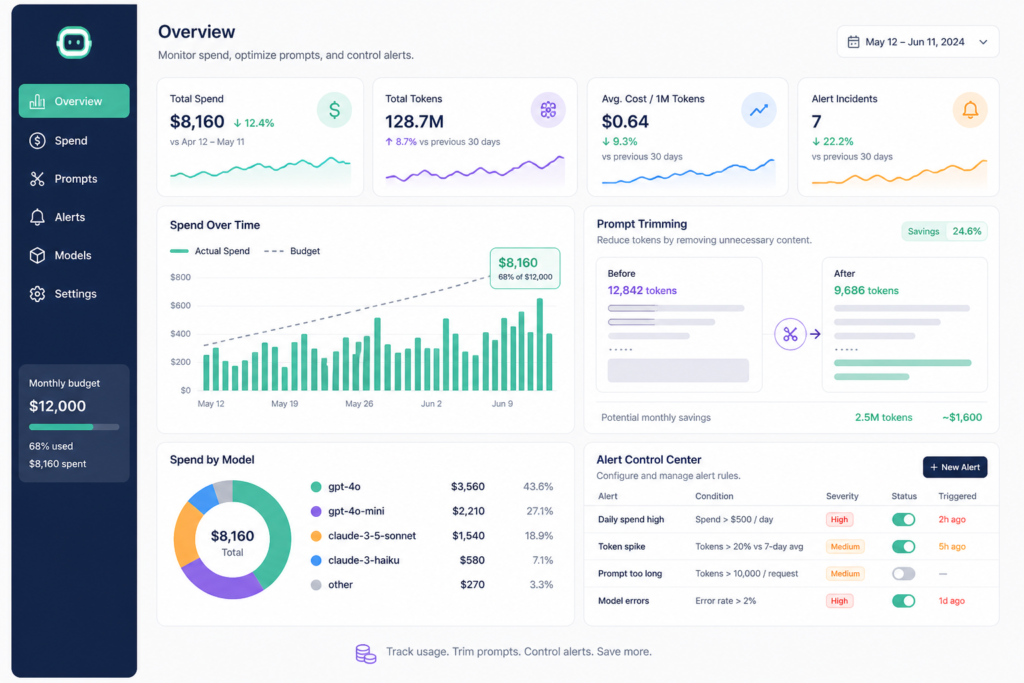
OpenAI invoice shows total spend—but not who caused it. Add internal tracking.
- Use separate API keys per feature or client, then tag logs accordingly.([reddit.com](https://www.reddit.com/r/LLMDevs/comments/1vq6cid/our_openai_bill_tells_us_what_we_spent_not_who/?utm_source=openai))
- Build a proxy that calculates estimated USD per call (model + tokens) and logs attributes—team, feature, customer.([reddit.com](https://www.reddit.com/r/LLMDevs/comments/1vq6cid/our_openai_bill_tells_us_what_we_spent_not_who/?utm_source=openai))
How do you maintain visibility and ROI over time?
Set the dashboard and alerts to drive value, not just spend.
- Export monthly cost CSV from dashboard for analysis and reconciliation.([help-lb.openai.com](https://help-lb.openai.com/en/articles/20001072-how-do-i-export-monthly-usage-details-from-the-api-usage-dashboard?utm_source=openai))
- Track cost per delivered outcome (e.g., cases resolved, insights generated).([openai.com](https://openai.com/index/managing-ai-investments-in-agentic-era/?utm_source=openai))
- Combine spend view by model, team, and feature to spot runaway costs or inefficient workflows.([openai.com](https://openai.com/index/managing-ai-investments-in-agentic-era/?utm_source=openai))
Comparison: Cost Reduction Techniques at a Glance
| Technique | Effect on Cost | Implementation Complexity |
|---|---|---|
| Prompt caching | ~90% token cost saved on repeats | Medium (needs gateway/cache layer) |
| Batch API | ~50% cheaper per request | Low–Medium |
| Model right-sizing / routing | Variable—often 2–10× savings | Medium |
| Prompt tuning and trimming | 10–30% token reduction | Low |
| Spend limits & prepaid caps | Prevents overruns | Low |
| Internal cost attribution | Improves accountability | Medium (logging infrastructure) |
Illustration: caching and routing flow for API requests
Frequently Asked Questions
What is the biggest lever to reduce OpenAI API cost?
Prompt caching often gives the largest single saving—identical calls can cost as little as 10% of the input rate. Caching even a part of frequent prompts compounds rapidly.
Will switching to a smaller model reduce quality?
Not necessarily. Many workloads—classification, pattern extraction, formatting—perform equally well on smaller versions. Always evaluate on real cases to confirm quality remains acceptable.
How much can Batch API reduce cost?
Batch API handles async jobs at approximately 50% of the cost of live calls. It’s ideal for non-user-facing workloads like data enrichment or offline evaluation.
Do prepaid credits help reduce API spend?
They help manage cash flow by limiting renewal, but don’t lower per‑token price. Credits expire after one year, so unused balance has a hidden cost.
How can I avoid unexpected token explosions in prompts?
Trim redundant instructions, remove whitespace and examples in system prompt, use structured output, and set reasonable max_tokens for completion. Each token you avoid directly lowers cost.